Blog
Balinese Cremation Ceremony: How Tourists Can Attend (2026)

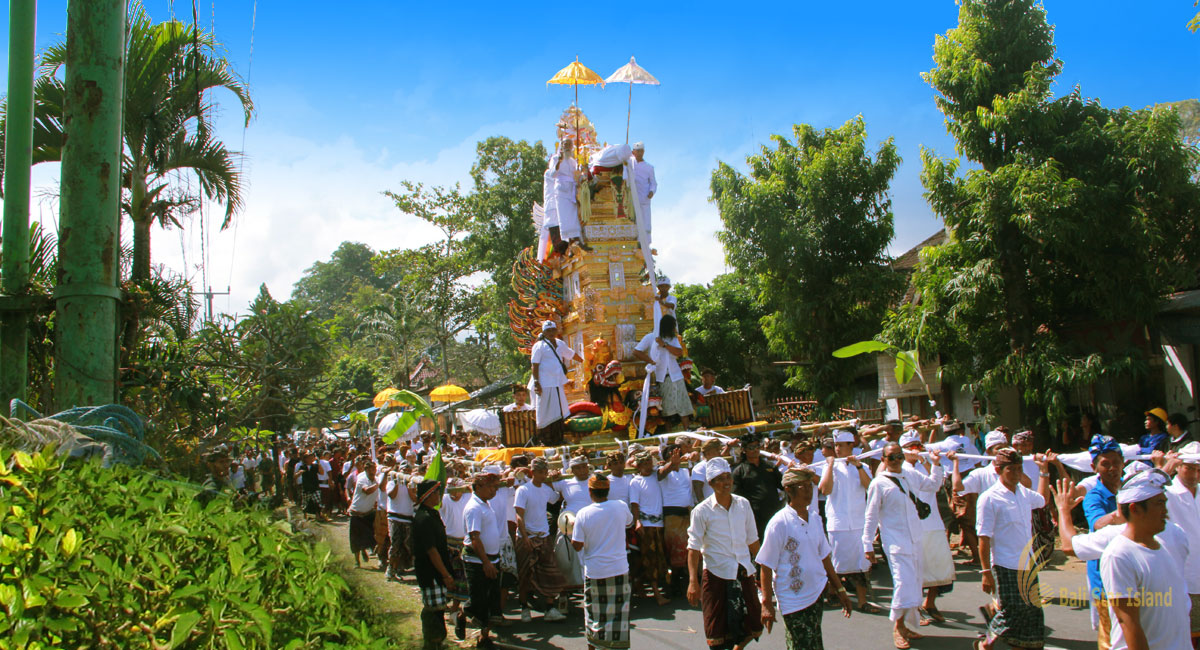
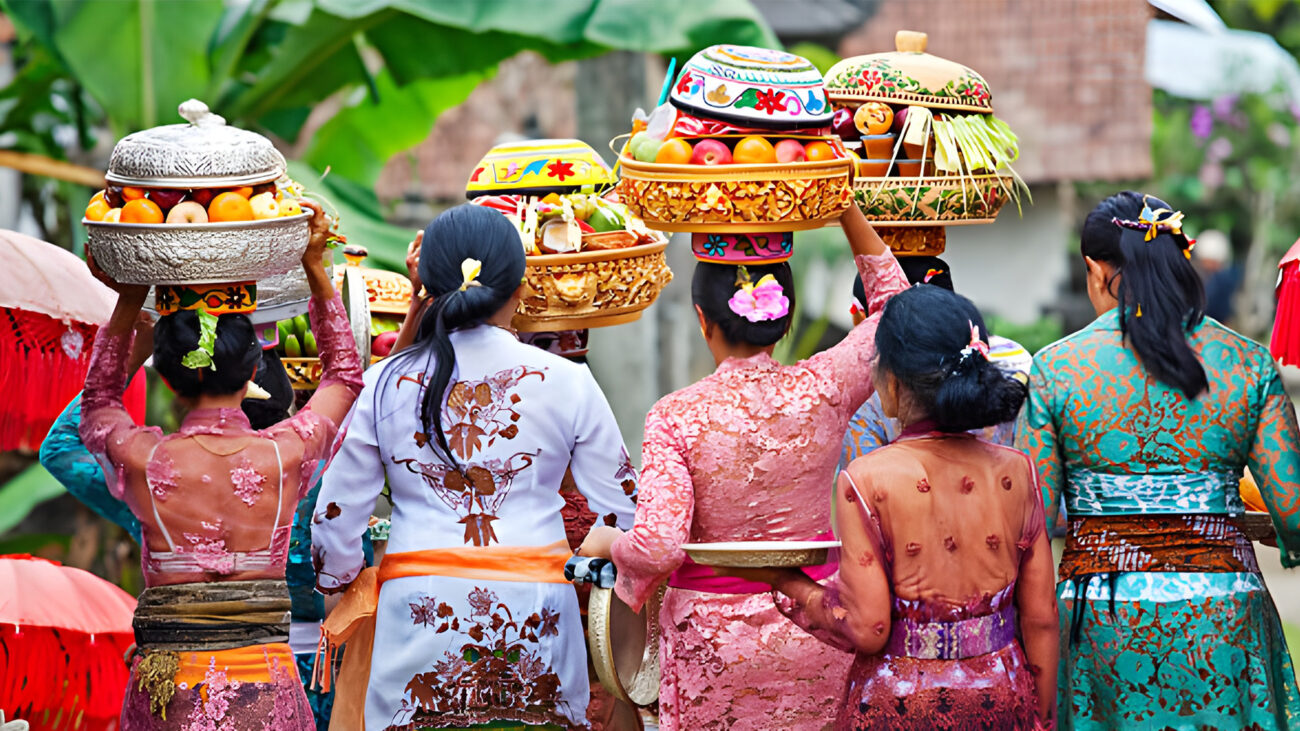
You might hear it before you see it. A wave of gamelan music — bright cymbals, deep drums — drifting through the streets of Ubud. Then a procession turns the corner: dozens of men in white traditional dress carrying an enormous, ornately decorated tower, its many-tiered roof swaying above the crowd. Behind it, a giant gilded bull. Incense smoke. Chanting. Women balancing towers of fruit and offerings on their heads. Children running alongside. The whole village, moving together.
This is Ngaben — the Balinese Hindu cremation ceremony. And if you are lucky enough to witness one during your time in Bali, it will be unlike anything you have ever seen at a funeral.
That’s because, to the Balinese, it isn’t a funeral in the Western sense. It is a celebration. A sacred, joyful act of releasing the soul from its earthly body so it can continue its journey toward reincarnation — or, for those who have lived with great virtue, toward moksha, spiritual liberation. Ngaben is one of the most profound cultural experiences a traveller can witness in all of Southeast Asia. This guide explains what it is, how to find one, how to be invited, what to wear, how to behave, and why it matters.
What is the Balinese Cremation Ceremony (Ngaben)?
Ngaben — also called Pitra Yadnya or, for higher-caste ceremonies, Pelebon — is the Hindu Balinese cremation ritual designed to release the soul (atma) from the physical body so it can continue its spiritual journey. Unlike funeral practices in many parts of the world, the ceremony is not mournful. Instead, it is a celebration of the soul’s freedom — an energetic, communal moment that reflects the Balinese belief in harmony between the seen and unseen worlds.
The Balinese view the physical body as a temporary vessel made of five elements — earth, fire, air, water, and ether. When the body dies, the soul moves on to another body based on the principles of Samsara — reincarnation. The cremation fire is not an ending. It is the mechanism of release — the body returning its elements to nature so the soul can move forward.
What makes Ngaben visually extraordinary is its scale and colour. Families collaborate with the banjar (village community) and temple specialists to craft offerings, build effigies, and organise logistics. Key elements include the Wadah or bade — a tall, decorated cremation tower used to transport the body — the Lembu, an animal-shaped sarcophagus often in the form of a bull, and offerings (banten) representing gratitude, purification, and guidance for the soul.
Why a Bull?
The lembu (bull) is the vehicle of Siwa — as the ‘destroyer’, Siwa symbolises death and the recycling of spirit. As the most prestigious sarcophagus shape, the lembu is normally reserved for high-caste cremations. The gender and status of the deceased determine which animal form is used — other shapes include the Gajah Mina (a large fish with an elephant head) and various mythical creatures. Each carries deep symbolic meaning about the soul’s status and its journey ahead.
Why Does the Tower Get Spun at Intersections?
The coffin is spun at intersections — a symbolic gesture to “confuse” negative forces and ensure the soul’s safe passage. It might sound mythical, but it is taken with complete seriousness by everyone involved. Watch for this moment during the procession — it takes dozens of men to rotate the tower, and the coordination required is extraordinary.
Types of Ngaben: What You’re Most Likely to See
Not all Ngaben ceremonies are the same. Understanding the differences helps you know what to expect:
- Individual Ngaben: Held shortly after death, usually by families with sufficient resources. Smaller in scale, more intimate. You are less likely to encounter these by chance.
- Communal Ngaben (Ngaben Ngirim): Multiple families pool resources for one shared ceremony. Ordinary people can wait until communal funeral ceremonies happen to share the cost. Meanwhile, they have to find or borrow money. In some cases, bodies stay buried for years because families are not able to save enough. These large-scale ceremonies are more common in villages and more likely to welcome observers.
- Royal or High-Priest Ngaben (Pelebon): Royal family members and high priests in Ubud or Denpasar have the largest gatherings and most exquisite ceremonial burial towers, up to 20 metres tall. These are the most spectacular and most tourist-accessible — Ubud Palace (Puri Saren Agung) ceremonies in particular often draw hundreds of visitors alongside the local community.
How to Find a Balinese Cremation Ceremony as a Tourist
This is the question most guides skip over. The honest answer: there is no official calendar, no app, and no booking system. Ngaben dates are chosen by priests based on the Balinese calendar and the family’s readiness. Here is how to actually find one:
1. Ask Your Accommodation Host
If you’re staying in Ubud, strike up a conversation with the locals or your homestay hosts. They’ll often know when a ceremony is taking place, and they might even invite you to join. A warung owner, a driver, a guesthouse manager — anyone embedded in the local community will know if a ceremony is happening nearby. Ask genuinely, with curiosity rather than demand.
2. Watch for Signs in the Street
Umbul-umbul and penjor — tall ceremonial flags and bamboo arches — signal a sacred event. When you see these lining a village street, something ceremonial is imminent or underway. Slow down, watch, and follow the sound of gamelan.
3. Search Online for Upcoming Royal Ceremonies
You can always search online for the upcoming royal or priest cremation ceremonies. Ubud-focused Facebook groups, local Bali tourism boards, and expat community forums (search “Bali expat community” + Ngaben) sometimes post notice of large upcoming ceremonies. Royal Ngaben at Ubud Palace is usually announced publicly, attracts large crowds, and is genuinely welcoming to respectful visitors.
4. Be Open to Stumbling Upon One
Many travellers encounter Ngaben unexpectedly — following a sound, turning a corner, finding themselves swept into a procession. In villages like Pengosekan, Mas, and Sidemen, you might stumble upon a local procession. If this happens to you, slow down, follow the etiquette in this guide, and consider yourself extraordinarily lucky.
How to Get Invited to a Balinese Cremation Ceremony
The question of invitation carries a weight that many travel articles dismiss too casually. The best approach is to attend only with permission, dress modestly, and treat the ceremony as a sacred event rather than a sightseeing stop. Local customs vary by village and family, so guidance from your host matters.
For large royal or communal ceremonies, no explicit invitation is typically required — visitors are welcome to observe from appropriate positions. For smaller, family ceremonies, the etiquette is different:
- If a local friend, driver, homestay host, or guide invites you — accept graciously, follow their lead on every detail of behaviour, and bring a small offering or donation for the family if they advise it.
- If you encounter a smaller family ceremony without being invited, observe from the outer edges of the street only. Do not enter the family compound unless specifically welcomed in by a family member.
- Never arrive as part of a tour group to a small village ceremony without prior community approval. The difference between a welcomed visitor and an intrusive one is felt immediately by the people involved.
What to Wear to a Balinese Cremation Ceremony
Dress code is strictly observed and non-negotiable. Both men and women should wear a traditional Balinese sarong and a sash (selendang) tied around the waist. Shoulders should be covered. A simple white shirt or a traditional Kebaya (for women) or Safari (for men) is highly appreciated.
Practical breakdown:
- Sarong: Covering legs to at least mid-calf. Bring your own — don’t rely on borrowing at a ceremony.
- Sash: Tied around the waist over the sarong. White or light-coloured is best.
- Top: Covered shoulders. A white or light-coloured top is most respectful — white is what Balinese worshippers wear and signals reverence.
- For men: A white shirt, sarong, sash, and if possible the traditional Balinese headpiece (udeng). These can be bought in Ubud markets for around Rp50,000.
- Footwear: Sandals you can easily remove. You may be asked to take them off in certain areas.
- What to avoid: Black clothing, revealing clothes, bright printed tourist shirts, shorts without a sarong. If in doubt, overdress rather than underdress.
What Happens at a Ngaben Ceremony: Stage by Stage
Knowing what is happening helps you observe with genuine understanding rather than confusion.
Stage 1: Days of Preparation
Before the public ceremony, the family and banjar spend days — sometimes weeks — building the bade tower and lembu sarcophagus, preparing offerings, and coordinating with priests. The procession is lively with gamelan music, chanting, and coordinated movements that create an atmosphere of sacred energy. As a visitor, you may be able to observe the bade and lembu being constructed in the family compound in the days leading up — ask your local contact if this is possible.
Stage 2: The Procession
The most visually spectacular part. The body, placed inside the bade tower, is carried on the shoulders of dozens of men through the village streets to the cremation ground. A long white cloth known as “lancingan” will be placed from one end of the tower down to the people carrying the structure. A line of women with offerings on their heads will follow the crowd along with other mourning relatives. The gamelan plays continuously. The tower is spun at intersections. As a visitor, friends, villagers, and curious people passing by are welcome to join the procession at the back.
Stage 3: Arrival at the Cremation Ground
The cremation ground is typically located near the village’s Pura Dalem (death temple). A member of the family will use a sacred dagger to open the coffin’s back after it has been placed on the white-clothed pavilion. The body or bones will be placed then inside the sarcophagus together with clothes, offerings, and accessories.
Stage 4: The Priest’s Blessing and the Fire
The high priest reads mantras and blesses the sarcophagus with holy water. When the time comes, the high priest will use a blessed fire torch to start the pyre. This is the spiritual core of Ngaben — the moment of release. It is intense, emotional for the family, and profound for any respectful witness. Stand at a distance. Do not photograph. Be still.
Stage 5: After the Fire
After cremation, the ashes and bone fragments are collected and eventually scattered into the sea or a river — returning the five elements fully to nature and completing the soul’s release from the physical world.
How to Behave During the Ceremony: The Essential Rules
- Stay quiet. Balinese believe that negative energy can disrupt the soul’s passage. Avoid loud chatter, laughter, or animated gestures.
- Stay low. Never position yourself higher than the priests or sacred objects. Do not climb anything for a better view.
- Stay at the back or edges. The inner areas of the procession and cremation ground are for family and community members. Your place as a visitor is at the outer edges — close enough to witness, far enough to not intrude.
- Use your right hand. If you give or receive anything — offerings, food, a gift — always use your right hand or both hands.
- Do not touch the offerings, tower, or sarcophagus. These are sacred objects, not props for photographs.
- Do not block pathways. The procession needs to move. If you are in the way, step aside immediately.
- Turn your phone to silent before the ceremony begins. A ringtone during the priest’s mantras is an intrusion that cannot be undone.
Photography at a Ngaben Ceremony: A Clear Guide
This is where the most visitor mistakes happen. Only photograph with clear permission. Some families are comfortable with respectful photography from a distance; others prefer no recording at all. When in doubt, don’t film.
Practical guidance:
- During the procession: Photography is generally accepted from a respectful distance. Keep your camera low, avoid using flash, and do not push forward for a better angle.
- During the priest’s mantras and the lighting of the pyre: Put your camera away. This is the most sacred moment of the ceremony.
- Photographing family members grieving: Never. Full stop.
- Photographing the sarcophagus and tower: Generally fine during the procession and pre-ceremony. Ask your local guide or host to confirm.
- Video: Follow the same rules as photography, with extra caution. A camera pointed at someone during prayer is intrusive regardless of whether it’s video or stills.
- The golden rule: if you have to ask whether it’s appropriate to photograph something, the answer is probably no.
Should You Feel Comfortable Attending as a Tourist?
This is a question worth sitting with honestly. The Balinese have a remarkable and genuine openness toward visitors at their ceremonies — far more so than most cultures in the world. They believe that the more people who witness and honour the ceremony, the more auspicious the energy surrounding the soul’s departure. Visitors are not intrusions; they can be welcome presences, provided they arrive with genuine respect rather than curiosity that turns everything into content.
The distinction the Balinese notice is not whether you have a camera — it is whether you are truly present, truly respectful, and truly moved by what you are witnessing. If you read this guide, dress appropriately, stay quiet, and approach the ceremony as a privilege rather than an attraction, you will be welcomed.
If you are there purely for the photos, the locals will sense it. And they will be right to.
Quick Reference: Ngaben Ceremony Checklist for Tourists
| What | Do | Don’t |
|---|---|---|
| Dress | Sarong, sash, covered shoulders, white or light top | Shorts, tank tops, black clothing, beach wear |
| Position | Outer edges, back of procession, below sacred objects | Inner family areas, elevated positions, blocking paths |
| Sound | Silent phone, hushed voice, respectful quiet | Ringtones, loud conversation, laughter |
| Photography | Procession from a distance, tower and offerings | During mantras, pyre lighting, grieving family members |
| Touch | Nothing sacred. Right hand for giving/receiving. | Offerings, tower, sarcophagus, people’s heads |
| Invitation | Large ceremonies: observe freely. Small: wait for invitation. | Enter family compounds uninvited |
Final Thought: A Privilege, Not an Attraction
Witnessing Ngaben is one of the rarest gifts Bali offers to travellers. Most tourists leave the island having seen its beaches, its terraces, its temples — but never having witnessed its soul. A cremation ceremony shows you how a culture actually understands life, death, community, and the divine. Not through a museum exhibit or a cultural show, but in real time, with real families, in the streets of a real village.
Approach it with that weight. Dress for it. Quieten yourself for it. Put your phone down during the moments that matter most. And when the fire is lit and the gamelan plays and the smoke rises, let yourself be moved — because you are standing at the edge of something genuinely ancient, genuinely beautiful, and genuinely not about you.
That’s the whole point of being there.
Want to understand Bali more deeply before you visit? Read our guide to Bali temple etiquette and learn how to get around Bali to reach the villages where ceremonies like Ngaben are still part of daily life. Explore our collection of authentic Balinese crafts — handmade by the same communities who carry these traditions forward.
Have you witnessed a Ngaben ceremony in Bali? Share your experience in the comments — especially any tips for visitors who want to attend with genuine respect.